
 By Claire Whitaker
Quick answer
Our overall pick is the MidwestHearth Potting Soil Mix, a ready-to-use blend of peat moss, perlite and vermiculite in an 8-quart bag. If you are shopping for a potting soil mix for indoor plants, the larger Michigan Peat bags suit bulk repotting, the Harris mix suits container growers who want added worm castings, and the Espoma seed starter suits seedlings and cuttings.
Choosing a potting soil mix for indoor plants is less about brand names and more about what is in the bag. Houseplants live in containers with limited room for roots, so the texture, drainage and moisture-holding ability of the mix matter considerably. The right bag for a snake plant on a windowsill may not be the best fit for a seedling tray or a hanging basket.
In this roundup we compare six bagged mixes sold on Amazon. Each description below is based only on the manufacturer’s listing and specifications. For general care and plant ideas, browse our Indoor Plants category or the broader Plant Care section.
Our picks at a glance

Pros
- Ready to use from the bag
- Lists peat moss, perlite and vermiculite
- Described as pH-controlled for many plant types
- Title states Made in USA
Cons
- The listing does not mention added fertilizer
- Only the 8-quart size is listed

Pros
- Largest bag in this roundup at 40 pounds
- Listed for indoor and outdoor use
- Ready to use out of the bag
- Organic peat moss listed as an ingredient
Cons
- Listing describes it as both moisture retaining and a succulent soil
- The listing does not mention whether the bag has a handle
- The listing does not mention a pH level

Pros
- Worm castings listed as a nutrient source
- Pumice and perlite listed for drainage
- Coco coir listed for moisture
- Listed for indoor and outdoor use
Cons
- Smaller 4-quart size per the title
- The listing does not give a feeding schedule
- The listing does not say how long the nutrients last

Pros
- Ready to use
- Broad list of plant uses in the features
- Listed for indoor and outdoor gardening
- Described as eco-friendly
Cons
- The listing does not name the ingredients
- Spec sheet shows two packs, so confirm quantity
- The listing does not mention drainage or pH
Pros
- Bulk bag at 20 pounds
- Listing says no added fertilizer is required
- Listed for indoor and outdoor use
- Ready to use out of the bag
Cons
- You will need to plan your own feeding routine
- The listing does not state an ingredient ratio
- The listing does not mention a pH level
Pros
- Listed for all seedlings and cuttings
- Described as organic and all natural
- Mycorrhizae blend listed
- Available in an 8-quart bag
Cons
- Listing is aimed at seedlings and cuttings rather than general container planting
- The listing does not mention added fertilizer
- The listing does not mention a pH level
How we chose
We compared manufacturer listings and specifications on Amazon as of November 2026. Every statement here reflects what the listing says.
The criteria were the ingredients named in the listing, the bag size and weight, whether the listing states indoor or outdoor use, whether the mix lists added nutrients, and whether the listing data is consistent. Where a spec field contradicted the title, we left that detail out.
Best Potting Soil Mix for Indoor Plants: our picks in detail
1. Best overall: MidwestHearth Potting Soil Mix, 8 Quarts
The MidwestHearth Potting Soil Mix comes in an 8-quart bag and is described as ready to use straight from the bag. The listing names peat moss, perlite and vermiculite as its ingredients and says the blend provides aeration and moisture retention. The features also state that the mix is pH-controlled for a broad range of plant types and promotes root growth.
The listing’s unit count does not match the 8-quart size in the title, so we left that detail out and relied on the title and volume. The listing does not say whether the mix contains added fertilizer, and it lists only the one bag size.
Best for: Indoor pots and houseplants where you want a ready-to-use peat, perlite and vermiculite blend in a single 8-quart bag.
Pros
- Ready to use from the bag
- Lists peat moss, perlite and vermiculite
- Described as pH-controlled for many plant types
- Title states Made in USA
Cons
- The listing does not mention added fertilizer
- Only the 8-quart size is listed
2. Best for large bulk repotting: Garden Magic Michigan Peat 5740, 40 lb
This Michigan Peat Garden Magic General Purpose Potting Soil Mix comes in a 40-pound bag, the heaviest option in this roundup. The listing describes a dark blend of reed sedge peat, organic peat moss and other materials. It is presented for indoor and outdoor use, including flower pots, raised garden beds and other planters, and is described as ready to use out of the bag with no additional mixing.
The listing says the mix is designed to retain enough moisture through moderate dry spells. It also calls the product a succulent soil, which does not fit neatly with a moisture-retaining description, so check that it suits your particular plants. We left out the listed volume because it does not fit a 40-pound bag.
Best for: Large repotting projects or several containers that each need a lot of mix at once.
Pros
- Largest bag in this roundup at 40 pounds
- Listed for indoor and outdoor use
- Ready to use out of the bag
- Organic peat moss listed as an ingredient
Cons
- Listing describes it as both moisture retaining and a succulent soil
- The listing does not mention whether the bag has a handle
- The listing does not mention a pH level
3. Best for nutrient-added container mixes: HARRIS All Purpose Premium Potting Soil Mix
The HARRIS All Purpose Premium Potting Soil Mix is listed with worm castings and other nutrients. The features name pumice, perlite and coco coir as components, and say the mix is for indoor and outdoor container gardening, flower boxes, hanging baskets and more. The title gives a 4-quart size.
The listing says the worm castings provide iron, sulfur, calcium, nitrogen, phosphorus and potassium, and that the pumice and perlite promote root aeration and fast drainage. The coco coir is described as helping maintain moisture. Its unit count and volume fields do not agree with the title, so we rely on the 4-quart size in the title.
Best for: Container growers who want a fast-draining mix with worm castings for pots and hanging baskets.
Pros
- Worm castings listed as a nutrient source
- Pumice and perlite listed for drainage
- Coco coir listed for moisture
- Listed for indoor and outdoor use
Cons
- Smaller 4-quart size per the title
- The listing does not give a feeding schedule
- The listing does not say how long the nutrients last
4. Best for mixed indoor and outdoor plantings: Lambert Potting Mix, 8 Quarts
The Lambert Potting Mix is described as a ready-to-use, all-purpose mix for indoor and outdoor gardening. The features list flowering plants, hanging baskets, foliage, cuttings, shrubs, vegetables and tropical plants as suitable uses. The listing also describes the product as eco-friendly and formulated to promote healthy plant growth. The title and volume both give 8 quarts.
The listing does not name the ingredients, so readers who want a specific peat, bark or coir blend should check the bag before buying. The spec sheet lists two packs, so confirm the quantity on the product page before ordering.
Best for: Mixed indoor and outdoor plantings where you want a general-purpose mix with a broad list of plant uses.
Pros
- Ready to use
- Broad list of plant uses in the features
- Listed for indoor and outdoor gardening
- Described as eco-friendly
Cons
- The listing does not name the ingredients
- Spec sheet shows two packs, so confirm quantity
- The listing does not mention drainage or pH
5. Best mid-size bulk bag with no added fertilizer: Garden Magic Michigan Peat 5720, 20 lb
The Michigan Peat 5720 Garden Magic General Purpose Potting Soil Mix comes in a 20-pound bag and is described as a bulk, dirt-free planting mix for indoor and outdoor use. The listing names reed sedge peat, organic peat moss and other materials, and says the mix is ready to use out of the bag with no additional mixing.
The features list vegetables, flowers and tomato plants among the suitable uses for containers, planters and pots. The listing says no added fertilizer is required and describes moisture retention during moderate dry spells. We relied on the 20-pound weight in the title and left out the listed volume, which does not fit a bag of this weight.
Best for: Mid-size bulk refills for containers, planters and garden projects that do not need added fertilizer.
Pros
- Bulk bag at 20 pounds
- Listing says no added fertilizer is required
- Listed for indoor and outdoor use
- Ready to use out of the bag
Cons
- You will need to plan your own feeding routine
- The listing does not state an ingredient ratio
- The listing does not mention a pH level
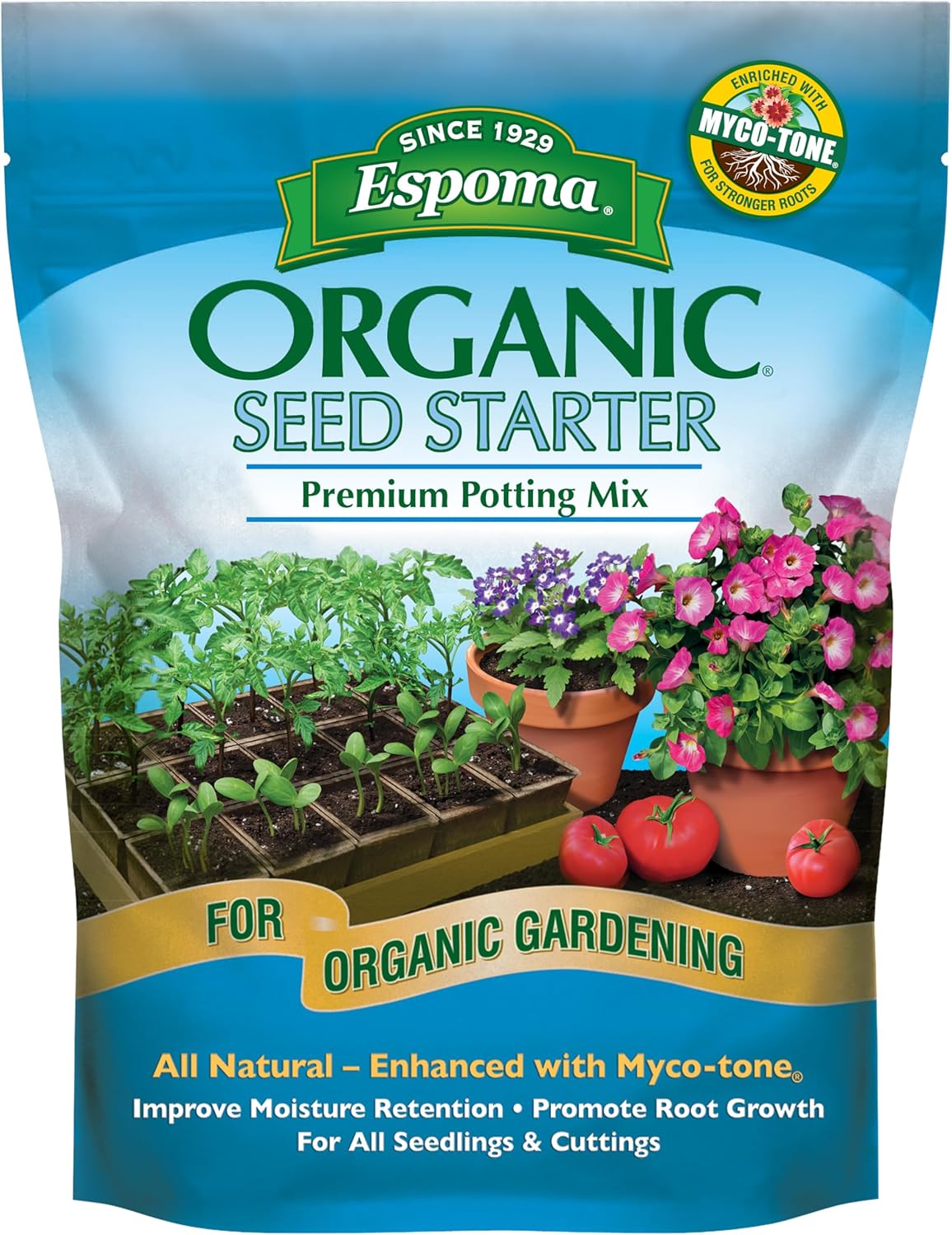
6. Best for seed starting and cuttings: Espoma Organic Seed Starter, 8 qt
The Espoma Organic Seed Starter Premium Potting Soil Mix comes in an 8-quart bag and is listed for all seedlings and cuttings. The features name sphagnum peat moss, peat humus and perlite as ingredients and say the mix is enhanced with Myco-tone, a blend of mycorrhizae. The listing describes it as an all-natural, organic product that promotes root growth.
The listing says the Myco-tone blend helps increase nutrient and water uptake and supports larger plants with more abundant blooms. These are the manufacturer’s claims. The included components field is a placeholder, so we relied on the feature bullets for details.
Best for: Seed starting and cuttings, especially for growers who want an organic mix that includes mycorrhizae.
Pros
- Listed for all seedlings and cuttings
- Described as organic and all natural
- Mycorrhizae blend listed
- Available in an 8-quart bag
Cons
- Listing is aimed at seedlings and cuttings rather than general container planting
- The listing does not mention added fertilizer
- The listing does not mention a pH level
Potting soil picks at a glance
| Product | Bag size | Listed ingredients | Indoor and outdoor use | Added nutrients or fertilizer |
|---|---|---|---|---|
| MidwestHearth Potting Soil Mix | 8 quarts | Peat moss, perlite, vermiculite | Not listed | Not listed |
| Garden Magic Michigan Peat 5740 | 40 lb | Reed sedge peat, organic peat moss, other materials | Yes | Not listed |
| HARRIS All Purpose Premium Potting Soil | 4 quarts (per title) | Worm castings, pumice, perlite, coco coir | Yes | Worm castings listed |
| Lambert Potting Mix | 8 quarts | Not listed | Yes | Not listed |
| Garden Magic Michigan Peat 5720 | 20 lb | Reed sedge peat, organic peat moss, other materials | Yes | Listing says no added fertilizer required |
| Espoma Organic Seed Starter | 8 quarts | Sphagnum peat moss, peat humus, perlite | Not listed | Not listed (mycorrhizae blend listed) |
How to choose a potting soil mix for indoor plants
Start with the plant, not the bag. Some houseplants prefer a mix that drains quickly and dries out between waterings, while others are happiest with a mix that holds more moisture. Read the feature list and ingredients on the listing and match them to what your plant needs.
Next, look at what the mix is made of. Many bagged mixes are built on peat moss or coco coir, with perlite, pumice or vermiculite added to improve air space and drainage. A listing that names its components gives you more to work with than one that does not. If an ingredient list is missing, ask the seller or check the bag before you buy.
Consider nutrients. Some mixes list added worm castings or other amendments, and some state that no added fertilizer is required. Neither type is automatically better. If the listing does not say what is added, plan to feed your plants according to the directions for each plant type.
Think about size. A small bag is easier to handle and store, but repotting several containers may call for a larger bag. Check the weight and the listed volume, and keep in mind that listed specs are sometimes inconsistent. When they conflict with the title, trust the title and confirm on the product page.
Finally, check the indoor and outdoor use statement. Mixes labeled for both are often flexible, while mixes built for seedlings and cuttings are usually better suited to starting plants. Peat-based bags are common, and the listing for a peat-based mix should say whether it is organic. Handle any bag according to the directions printed on it, and follow the manufacturer’s instructions for mixing, watering and feeding. For plant problems that show up after repotting, our guide on ZZ plant yellow leaves covers common causes, and our guide to pests on indoor plants can help you check new soil and plants for trouble.
What to look for
- Named ingredients in the listing, such as peat moss, coir, perlite or pumice
- Bag size and weight that match how many containers you plan to fill
- A clear statement of indoor or outdoor use
- Whether added nutrients or fertilizer are listed or stated as not required
- Listing details that agree with the title, with conflicting specs checked on the product page
- Specialty uses, such as seed starting or cuttings, if that is your goal
FAQ
Can I use garden soil from the yard in indoor pots?
Garden soil can be dense and may not drain well in a container. Many gardeners choose a bagged mix made for containers instead. Check the bag label for the intended use and follow the manufacturer’s instructions.
Do I need a potting soil mix with added nutrients?
Not always. Some listings in this roundup name added nutrients, such as worm castings, while others state that no added fertilizer is required. Whichever mix you choose, plan your feeding routine based on the needs of each plant.
Is the Espoma mix only for seeds?
The listing describes it for all seedlings and cuttings, and it is labeled as a seed starter. It is not described in the listing as a general-purpose mix for every container plant, so read the feature list before using it for other plants.
Why do some listings show conflicting sizes?
Amazon spec fields are sometimes inconsistent with the title. We left out conflicting values and relied on the title and weight where possible. Confirm the size, quantity and contents on the product page before you buy.
References
- Amazon product listings and manufacturer specifications (accessed November 2026)
About Claire Whitaker
Claire Whitaker is part of our editorial team and reviews and edits our plant care Q&A guides, checking product details against manufacturer specifications and owner feedback.
