
 By Claire Whitaker
Quick answer
The best fertilizer for indoor plants in this roundup is the TPSNutrients Indoor Plant Food, a liquid whose listing is written for houseplants. Miracle-Gro All Purpose suits mixed indoor and outdoor collections, Pour & Feed suits container growers who want no mixing, and Dr. Earth fits people who prefer an organic blend for vegetables and herbs. The Southern Ag granules and Scotts lawn food are for outdoor beds and lawns, not houseplants.
If you are shopping for the best fertilizer for indoor plants, the right choice depends on what you grow, how you water, and whether you want an organic product. Potted plants depend entirely on the soil and on what you add, so most houseplant owners use a liquid or water-soluble food mixed into regular watering. Some prefer a ready-to-use pour-on, and others want a granular or organic option for vegetables and herbs.
This roundup compares six Amazon listings. Two are written for houseplants or containers, one covers mixed indoor and outdoor plants, and the rest are aimed at outdoor beds, lawns, or vegetable gardens. We include those outdoor products so you can see clearly where they fit and where they do not. For background on houseplant care, see our indoor plants section.
Our picks at a glance

Pros
- Labeled specifically for indoor houseplants
- Liquid concentrate that mixes with water
- Kelp-enriched formula and Made in USA per listing
- Named plant list covers common houseplants
Cons
- Listed size is only 8 fluid ounces
- The listing does not state an NPK analysis
- Needs mixing with water before each feeding

Pros
- Clear lawn-specific fall use
- Listed for any grass type
- Coverage of 4,000 square feet per listed bag
- Spreads as granules
Cons
- Lawn use only; no houseplant use listed
- The listing does not mention indoor or container plants
- Granules are designed for spreading, not pot feeding

Pros
- Listed for indoor and outdoor plants
- NPK of 24-8-16 stated in listing
- One container for mixed collections
- Application by watering can per listing
Cons
- Needs mixing with water before use
- A 10 lb container is large for a small indoor collection
- The listing gives both granules and powder as item forms

Pros
- Organic and natural ingredients per listing
- No GMOs, chicken manure, or sewage sludge listed
- Includes beneficial soil microbes
- Feeds for several months per listing
Cons
- Written for vegetables and herbs, not houseplants
- Granular form; no indoor application directions listed
- The listing does not state an NPK analysis
Pros
- Balanced 10-10-10 analysis listed
- Uniform granular formulation per listing
- Wide list of outdoor uses
- Application method clearly stated
Cons
- Outdoor beds and trees focus; no houseplant use listed
- Broadcast method does not suit pots
- The listing does not mention indoor or container use

Pros
- Ready to use with no mixing
- Applied directly to soil
- Listed for indoor and outdoor containers
- Feeding frequency stated in listing
Cons
- Listed for potted plants, not in-ground beds
- The listing does not state an NPK analysis
- The listing names no specific plants beyond general categories
How we chose
We compared manufacturer listings and specifications on Amazon as of November 2026. We did not test any of these products by hand. Our picks come from reading what each listing states about its form, intended plants, application method, listed size, ingredients, and any organic claims.
The main criteria were whether the listing names indoor or houseplant use, the listed form (liquid, water-soluble, granules, or pour-on), how the listing says to apply it, and whether an NPK analysis or ingredient detail is given. Where a specification looked implausible or conflicted with the listing title, we left it out and did not repeat it.
Best Fertilizer for Indoor Plants: our picks in detail
1. Best overall: TPSNutrients Indoor Plant Food, 8 oz
The TPSNutrients Indoor Plant Food is a liquid complete fertilizer whose listing is written for indoor houseplants. The listing says it is formulated to provide balanced nutrition for houseplants and to support fuller leaves, healthy new growth, stronger roots, and vibrant green foliage. It names monstera, pothos, philodendron, snake plants, peace lilies, and fiddle leaf figs among the plants it suits.
The listing describes it as a liquid concentrate that mixes easily with water for feeding during regular watering routines. Its highlights include a kelp-enriched formula and a note on gentle weekly feeding, and the listing states it is made in the USA. The package is listed at 8 fluid ounces with a watering can as the application method. The listing does not state an NPK analysis.
Best for: Owners of a mixed group of houseplants who want a liquid that fits into weekly watering.
Pros
- Labeled specifically for indoor houseplants
- Liquid concentrate that mixes with water
- Kelp-enriched formula and Made in USA per listing
- Named plant list covers common houseplants
Cons
- Listed size is only 8 fluid ounces
- The listing does not state an NPK analysis
- Needs mixing with water before each feeding
2. Best for fall lawns (not indoor plants): Scotts Turf Builder WinterGuard, 10 lb
The Scotts Turf Builder WinterGuard Fall Lawn Food is a granular lawn fertilizer. It is included here as a clear example of a product that is not made for houseplants. The listing says it helps build strong, deep grass roots, supports lawns through summer heat, drought, and regular activity, and prepares roots for harsh winter conditions.
The listing says it can be used on any grass type and applied to a wet or dry lawn in the fall. It describes coverage of 4,000 square feet from one 10 lb bag and lists spreading as the application method. The listing does not mention indoor plants, containers, or houseplants. The item weight in the specifications does not match the 10 lb title, so we have left the weight out.
Best for: Homeowners fertilizing a lawn in the fall, not anyone feeding houseplants.
Pros
- Clear lawn-specific fall use
- Listed for any grass type
- Coverage of 4,000 square feet per listed bag
- Spreads as granules
Cons
- Lawn use only; no houseplant use listed
- The listing does not mention indoor or container plants
- Granules are designed for spreading, not pot feeding
3. Best for mixed indoor and outdoor collections: Miracle-Gro All Purpose Plant Food, 10 lb
Miracle-Gro Water Soluble All Purpose Plant Food is listed as feeding outdoor, in-ground, and indoor plants, including houseplants, vegetables, flowers, roses, and trees. The listing gives an NPK analysis of 24-8-16 and says it starts working quickly. Because one product covers both groups, it suits a home where indoor and outdoor plants share a feeding routine.
The listing gives a separate mixing instruction for indoor plants in a watering can and a different one for outdoor plants, so you should follow the label for each group. It states that one 10 lb container covers about 4,000 square feet of garden area. Its listed item forms are granules and powder, and the application method is a watering can. The listing does not describe a single dose for all plant types.
Best for: Households with both houseplants and outdoor beds that want one all-purpose product.
Pros
- Listed for indoor and outdoor plants
- NPK of 24-8-16 stated in listing
- One container for mixed collections
- Application by watering can per listing
Cons
- Needs mixing with water before use
- A 10 lb container is large for a small indoor collection
- The listing gives both granules and powder as item forms
4. Best organic option for vegetables and herbs: Dr. Earth Organic 5 Tomato & Herb, 4 lb
Dr. Earth Organic 5 Tomato, Vegetable and Herb Fertilizer is a granular product that the listing describes as made with 100% organic and natural ingredients. The listing says it contains no GMOs, chicken manure, or sewage sludge. It aims to supply optimum levels of primary plant nutrients for more nutritious and tasty vegetables.
The listing also says it contains beneficial soil microbes plus ecto and endo mycorrhizae, and that it feeds for several months. The listed item weight is 4 pounds, and the listed specific use is organic. The listing is written around vegetables and herbs rather than houseplants, and it does not give indoor application directions or an NPK analysis.
Best for: Gardeners who want an organic granular feed for vegetables and herbs.
Pros
- Organic and natural ingredients per listing
- No GMOs, chicken manure, or sewage sludge listed
- Includes beneficial soil microbes
- Feeds for several months per listing
Cons
- Written for vegetables and herbs, not houseplants
- Granular form; no indoor application directions listed
- The listing does not state an NPK analysis
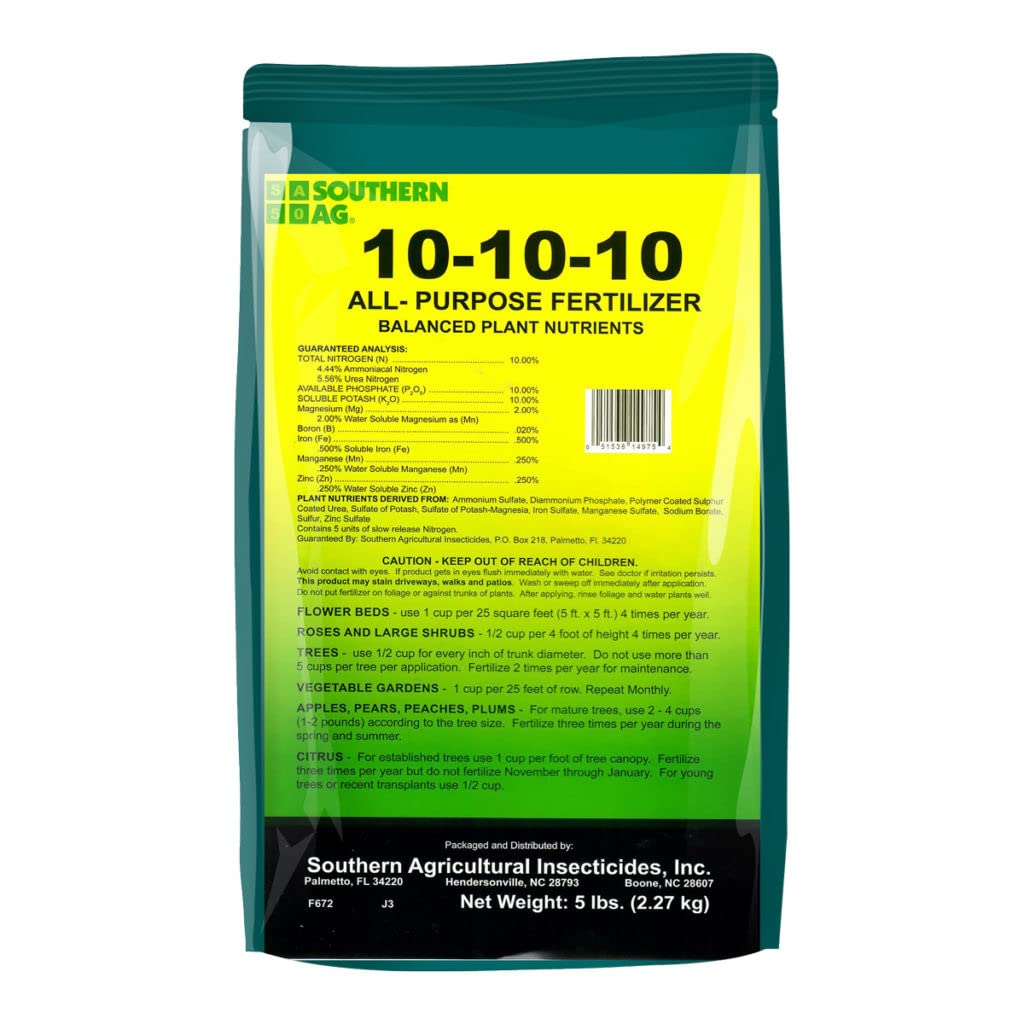
5. Best balanced granules for outdoor beds and trees: Southern Ag All Purpose 10-10-10, 5 lb
Southern Ag All Purpose Granular Fertilizer is a 10-10-10 product. The listing gives 10% nitrogen, 10% phosphorus, and 10% potassium, plus minor elements, and describes a uniform, homogenous granular formulation. Its listed specific uses are citrus and fruit trees, flowerbeds, roses, large shrubs, and vegetable gardens.
The listing says to broadcast the product evenly over the area and water it in. It gives coverage guidance for vegetable gardens and flowerbeds, roses and large shrubs, and fruit trees, all of which are outdoor uses. The package is listed at 5 pounds. The listing does not mention houseplants, containers, or indoor use. The seller shown in the brand field is Root 98 Warehouse.
Best for: Outdoor gardeners feeding beds, roses, and fruit trees with a balanced granular product.
Pros
- Balanced 10-10-10 analysis listed
- Uniform granular formulation per listing
- Wide list of outdoor uses
- Application method clearly stated
Cons
- Outdoor beds and trees focus; no houseplant use listed
- Broadcast method does not suit pots
- The listing does not mention indoor or container use
6. Best no-mix option for potted plants: Miracle-Gro Pour & Feed, 32 fl oz
Miracle-Gro Pour and Feed Plant Food is a ready-to-use liquid that the listing says requires no mixing with water or a watering can. You apply it directly to the soil. The listing describes it as a plant food for houseplants and flowers that instantly feeds indoor and outdoor container-grown plants.
The listing gives a feeding frequency of every 10 to 14 days and says it can be used indoors or outdoors on all container plants. The listed size is 32 fluid ounces, and the item form is liquid. The target species is listed as potted plants. The listing does not state an NPK analysis or name specific plants beyond the general category of houseplants and flowers.
Best for: Container growers who want to skip mixing and pour the feed straight onto the soil.
Pros
- Ready to use with no mixing
- Applied directly to soil
- Listed for indoor and outdoor containers
- Feeding frequency stated in listing
Cons
- Listed for potted plants, not in-ground beds
- The listing does not state an NPK analysis
- The listing names no specific plants beyond general categories
Fertilizers for indoor plants at a glance
| Product | Form | Listed use | Application method | NPK listed |
|---|---|---|---|---|
| TPSNutrients Indoor Plant Food | Liquid | Indoor houseplants | Watering can | Not listed |
| Scotts Turf Builder WinterGuard | Granules | Lawns, any grass type | Spread | Not listed |
| Miracle-Gro All Purpose Plant Food | Granules, powder | Indoor and outdoor plants | Watering can | 24-8-16 |
| Dr. Earth Organic 5 Tomato, Vegetable & Herb | Granules | Vegetables and herbs (organic) | Not listed | Not listed |
| Southern Ag All Purpose Granular | Granules | Outdoor beds, trees, roses | Broadcast and water in | 10-10-10 |
| Miracle-Gro Pour & Feed | Liquid | Potted plants, indoor and outdoor | Directly to the soil | Not listed |
How to choose the best fertilizer for indoor plants
Start with where the plant lives. Houseplants in pots depend entirely on what you give them, so a product labeled for indoor or houseplant use is the simplest starting point. When you compare options for the best fertilizer for indoor plants, look first at the listing’s stated use. The TPSNutrients and Pour and Feed listings name indoor or container use directly, while the lawn and bed products do not mention houseplants at all.
Next, match the form to your routine. Liquids and water-soluble powders mix into your regular watering. Granules are usually broadcast and watered in, which suits beds and trees better than a pot. Pour-on liquids skip mixing but still go onto the soil. Read the application method in each listing and follow the manufacturer’s directions for mixing and dosing.
Check the ingredient information. Some listings give an NPK analysis, such as 24-8-16 or 10-10-10, and others do not. If a listing gives no analysis, you cannot compare its nutrient balance with another product, so check the package label before you buy. If you prefer organic products, look for the listing’s ingredient details and any statements about what it leaves out.
Consider who shares your home. If pets are around, look up the plants you grow and any product ingredients before you buy, and see the ASPCA list of toxic and non-toxic plants. For broader planning, see our plant care section. If you grow both indoor and outdoor plants, our guide to annuals and perennials can help you plan which plants need feeding where.
What to look for
- Indoor or houseplant use named in the listing
- A form that fits your watering routine: liquid, water-soluble, granules, or pour-on
- A clearly stated application method
- An NPK analysis or clear ingredient details
- Organic claims that match what you want
- A package size that suits how many plants you grow
FAQ
Can I use lawn fertilizer on indoor plants?
The Scotts lawn food listing describes use on lawns only and does not mention houseplants, so it is not the right product for indoor plants. Always follow the manufacturer’s directions on any product you use.
What does NPK mean on a fertilizer label?
NPK stands for nitrogen, phosphorus, and potassium, the three main nutrients listed on many fertilizers. Two products here list their analysis: Miracle-Gro All Purpose at 24-8-16 and Southern Ag at 10-10-10. The other listings do not state one.
Do I have to mix every fertilizer?
No. The Miracle-Gro Pour and Feed listing says it needs no mixing and is applied directly to the soil. The TPSNutrients and Miracle-Gro All Purpose listings call for mixing with water, and the granular products are applied by broadcasting and watering in.
Is an organic fertilizer a better choice for houseplants?
The Dr. Earth listing emphasizes organic and natural ingredients, but it is written for vegetables and herbs and does not describe houseplant use. Choose based on your preference and what each listing actually states for the plants you grow.
References
- Amazon product listings and manufacturer specifications (accessed November 2026)
- ASPCA: Toxic and Non-Toxic Plants
About Claire Whitaker
Claire Whitaker is part of our editorial team and reviews and edits our plant care Q&A guides, checking product details against manufacturer specifications and owner feedback.




