

As an Amazon Associate I earn from qualifying purchases. This page may contain affiliate links.
Choosing a we the wild houseplant care kit can feel confusing, because most sets bundle fertilizer, tools and water treatments in very different combinations. Some are built for beginners who want one box with everything in it, while others focus on a single job such as repotting or pest control. This guide compares seven care kits from the Amazon US catalog and explains how each one fits a specific need. The picks were selected from published specifications, brand reputation and common owner feedback patterns, not from hands-on testing. Our criteria were what the kit actually contains, how useful those items are for everyday houseplant care, how much a beginner would need to learn before using them, and whether the contents make sense for indoor pots rather than outdoor beds.
Our Top Picks
Quick Comparison
| Product | Best for | Key feature |
|---|---|---|
| Indoor Glow & Care Kit | Beginners who want a complete set | Concentrated fertilizer plus root drops and leaf shine |
| Cute Farms Plant Care Kit | Organic-minded growers and gift buyers | Organic fertilizer with mycorrhizal fungi and neem oil |
| Back to the Roots Self Watering Grow Kit | Succulent and cactus owners who forget to water | Glass self-watering planters |
| UpBloom Plant Therapy Kit | Repotting and general household plant care | Potting-focused tools and supplies |
| Kikkerland Plant Care Kit | Casual plant owners and gift buyers | Compact, simple tool set |
| Altman Plants Succulent Fairy Garden Kit | Decorative terrarium and fairy garden projects | Four live succulents with accessories |
| Houseplant Care Tester Kit | Diagnosing light, moisture and nutrient problems | Test strips and meters for plant conditions |
Indoor Glow & Care Kit

Indoor Glow & Care Kit – Houseplant Care Set with Concentrated Fertilizer, Root Drops, Leaf Shine, Water Conditioner, Repotting Mat, Scissors & Guide
This set suits beginners who want most of the everyday supplies in one purchase. It is a good starting point if you have a handful of mixed houseplants and do not yet know which products you will reach for most often.
Key specs
- Concentrated houseplant fertilizer
- Root drops and leaf shine
- Water conditioner
- Repotting mat, scissors and included guide
Pros
- Covers feeding, root health, leaf cleaning and repotting in one box
- Useful for new owners who want a clear starting routine
- Includes a repotting mat that keeps soil off counters
Cons
- Concentrated products need careful dilution to avoid overfeeding
- Some items may go unused if you grow only a few plants
Cute Farms Plant Care Kit
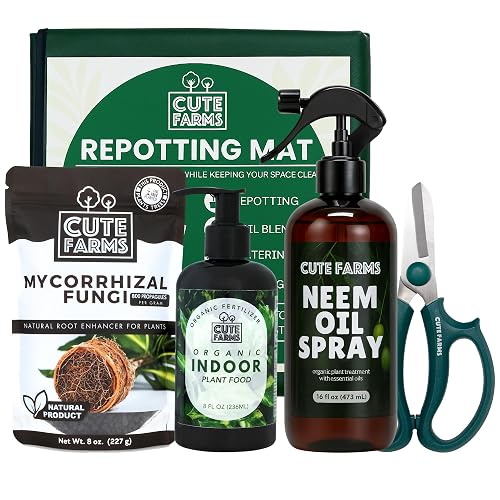
Cute Farms Plant Care Kit – Organic Houseplant Fertilizer, Mycorrhizal Fungi, Neem Oil & Scissors and Repotting Mat | All-in-One Gift for Indoor Plant Lovers
This kit fits owners who prefer organic inputs and want a gift that feels thoughtful. It works well for people who grow a mix of foliage plants and flowering houseplants indoors.
Key specs
- Organic houseplant fertilizer
- Mycorrhizal fungi for root support
- Neem oil for pest control
- Scissors and repotting mat
Pros
- Organic-focused ingredient list appeals to many growers
- Mycorrhizal fungi can support root establishment after repotting
- Neem oil gives a practical first step against common pests
Cons
- Neem oil should be tested on a leaf first, since some plants react badly
- Mycorrhizal products work best when used at planting, not every watering
Back to the Roots Self Watering Grow Kit

Back to the Roots Self Watering Grow Kit – Glass Hydroponic Planters for Succulents and Cacti Self-Watering System
This is a planter-based kit rather than a bottle-and-tool set. It suits owners of succulents and cacti who tend to overwater or forget watering altogether, and who want a more hands-off system.
Key specs
- Glass hydroponic planters
- Self-watering reservoir design
- Built for succulents and cacti
Pros
- Reservoir design reduces the risk of frequent overwatering
- Glass planters let you see water levels at a glance
- Good fit for small desk or windowsill displays
Cons
- Succulents in self-watering systems still need well-draining media to avoid root rot
- It does not include fertilizer or pest tools
UpBloom Plant Therapy Kit

UpBloom Plant Therapy Kit for Indoor Potting, Repotting and General Household Plant Care
This kit is aimed at the moments when a plant needs a fresh pot and new soil. It suits owners who repot regularly or who want a general-purpose set for household plant upkeep.
Key specs
- Designed for indoor potting and repotting
- General household plant care focus
Pros
- Focused on the potting tasks that many beginners find intimidating
- Fits repotting and root-check routines well
- Straightforward purpose makes it easy to decide if you need it
Cons
- Less useful if you need feeding or pest products as well
- Contents may vary by listing, so confirm details before ordering
Kikkerland Plant Care Kit

Kikkerland Plant Care Kit
This is a compact, simple kit for casual plant owners who want a few basic tools without a big bundle. It also works as a low-pressure gift for someone starting their first houseplant collection.
Key specs
- Compact basic plant care set
- Simple tool-focused design
Pros
- Small footprint suits shelves and small apartments
- Easy to understand what each item is for
- Gift-friendly presentation
Cons
- Fewer care products than the larger all-in-one sets
- Advanced growers may need to buy fertilizer and pest control separately
Altman Plants Succulent Fairy Garden Kit (4 Pack)

Altman Plants Succulent Fairy Garden Kit (4 Pack), Live Succulents Plants Live Houseplants, Fairy Garden Accessories Terrarium Plants, Indoor Plants Live Plants Indoor House Plants, Succulent Plants
This kit is less about maintenance and more about building a small display. It suits people who want live succulents and decorative accessories for a terrarium or fairy garden, and who are happy to care for a few plants in bright indirect light.
Key specs
- Pack of four live succulent plants
- Fairy garden accessories included
- Indoor-suitable live plant set
Pros
- Delivers living plants and decor together
- Good for learning succulent basics in a small space
- Useful for classroom or craft projects
Cons
- Live plants can arrive stressed, so allow time to adjust
- Not a care-supply kit, so you will still need your own fertilizer and tools
Houseplant Care Tester Kit

Houseplant Care Tester Kit
This is a diagnostic kit rather than a set of treatments. It suits growers who keep running into problems and want to check conditions like moisture, light or soil nutrients before changing their routine.
Key specs
- Plant condition testing tools
- Designed for checking houseplant growing conditions
Pros
- Takes guesswork out of watering and light decisions
- Helpful for diagnosing slow growth or yellowing leaves
- Useful alongside any other care kit
Cons
- Test readings are only a guide and should be read alongside plant appearance
- Does not feed, repot or treat pests
Buying Guide
Selection criteria
A good houseplant care kit should match the plants you actually own. A kit built around succulents will not help a fern grower, and a fertilizer-heavy set is wasted on someone who mainly needs a repotting tool. Start by listing your plants, their light conditions and your most common problems, then compare kits against that list rather than against the marketing photos.
Important features
- Contents you will use: Count how many items you would reach for in a typical month.
- Product form: Concentrated liquids stretch further but need accurate measuring. Ready-to-use sprays are simpler but cost more per use.
- Organic or conventional ingredients: Check the label if this matters to you.
- Tool quality: Scissors should be sharp and stainless, and a repotting mat should be large enough for your pots.
Specs to check
- Full ingredient list and label directions
- Whether fertilizer is concentrated or ready to use
- Whether the kit includes live plants, planters or only supplies
- Included instructions or guide
Choosing by need
- Complete beginner: A full-contents set such as the Indoor Glow & Care Kit gives you a routine to follow.
- Organic grower or gift buyer: The Cute Farms Plant Care Kit fits this profile.
- Forgetful waterer with succulents: The Back to the Roots Self Watering Grow Kit reduces watering decisions.
- Frequent repotter: The UpBloom Plant Therapy Kit is focused on this task.
- Diagnosing problems: The Houseplant Care Tester Kit helps you find the cause before you treat it.
Things to watch out for
- Concentrated fertilizers can burn roots if overused. Follow label dilution rates.
- Neem oil and similar treatments should be patch-tested on one leaf first.
- Self-watering planters still need drainage-friendly soil for succulents and cacti.
- Live-plant sets may need a few weeks to adjust after shipping.
FAQ
Is a houseplant care kit worth it for beginners?
It can be, especially if the kit includes fertilizer, a repotting mat and clear instructions. A kit saves you from buying each item separately while you are still learning which products your plants need. If you already own good soil and tools, a diagnostic or single-purpose kit may be a better fit.
How often should I use fertilizer from a care kit?
Most houseplants are fed during active growth, usually spring and summer, and fed lightly or not at all in winter. Follow the label for your specific product, since concentrated formulas differ in strength. When in doubt, use a weaker dilution than recommended.
Can I use neem oil on all houseplants?
Neem oil is widely used on houseplants, but some species react poorly, especially in strong sun or when sprayed in high heat. Test one leaf and wait a few days before treating the whole plant. Avoid spraying during the hottest part of the day.
Do I need a self-watering planter for succulents?
Not necessarily. Succulents are prone to overwatering, so a self-watering system can help, but it must use fast-draining media. A standard pot with drainage holes and a gritty mix works well for many owners who water deeply and wait for the soil to dry.
What does a houseplant tester measure?
Testers vary by product, but many aim to show soil moisture, light levels or nutrient status. Readings are a guide and should be combined with what you see in the plant, such as leaf color, new growth and soil texture.
Are live plant kits good for learning?
They can be. Live succulent sets let you practice watering and light placement on a small scale. Expect a short adjustment period after shipping, and keep the plants in bright indirect light until they settle.
Should I consult a professional about a sick plant?
For serious pest outbreaks, root rot or plants that continue to decline after changes in care, a local nursery or extension office can help identify the problem accurately. Product labels and care kits are useful for routine care but may not solve advanced disease issues.
Conclusion
For most people, the best choice among these seven depends on what they need to do most often. Beginners who want a broad starter set should look at the Indoor Glow & Care Kit, while organic-minded growers will likely prefer the Cute Farms Plant Care Kit. Succulent owners who struggle with watering may benefit from the Back to the Roots Self Watering Grow Kit, and frequent repotters can focus on the UpBloom Plant Therapy Kit. The Kikkerland Plant Care Kit works for casual owners and gifts, the Altman Plants Succulent Fairy Garden Kit suits decorative projects, and the Houseplant Care Tester Kit is most useful for diagnosing problems. Match the kit to your plants, read the labels before use, and add products only when a specific need appears.
Related reading
- Watermelon Peperomia Houseplant Care: 5 Best Picks Compared for Growers
- Water Lily Houseplant Care: A Step-by-Step Guide for Healthy Blooms
- Wandering Jew Houseplant Care: A Step-by-Step Guide for Healthy Growth
- Variegated Ginger Houseplant Care: A Step-by-Step Guide for Healthy Growth
- Strawberry Begonia Houseplant Care: A Step-by-Step Guide for Healthy Growth
- Small Leaf Spiderwort Houseplant Care: A Step-by-Step Guide for Healthy Growth




